"A balanced horse is a horse in good physical and mental health; humans can therefore evolve safely alongside a balanced horse."
On the contrary, a horse "not well in its mind" is an aggressive, stressed horse that wants to flee, and therefore dangerous for the humans around it.
A herd of balanced horses is a calm herd, where everyone finds their place and can eat, drink, and sleep as they wish, having the social interactions they need. Humans can therefore move safely within the herd.
In order to use a horse, work with it, ride it, compete, and perform well, the horse must be in excellent physical condition. If it is lame, it will be impossible to ride; if it has ulcers or is tired, it will be less performant, and so on.
For a horse to be balanced, the environment in which it lives must meet its fundamental needs:
Breathing is a common, normally easy act, because without respiration, there is no life. This is true for all living beings. Given its very fragile respiratory system, the horse particularly needs to breathe clean air or, at the very least, air free of dust.
That’s why life outdoors, in the open air, with optimal air circulation, is what suits horses best. Thus, we have naturally chosen to offer the horses on the property a life that is 100% outdoors.
The Domaine Équestre du Somaret, perched at 390 meters above sea level, enjoys exceptional air quality.
Tout comme respirer, le cheval a besoin de boire pour vivre, car sans eau, la vie s’arrête rapidement. Par conséquent, pour assurer une bonne hydratation, le cheval doit avoir un accès permanent à un point d’eau.
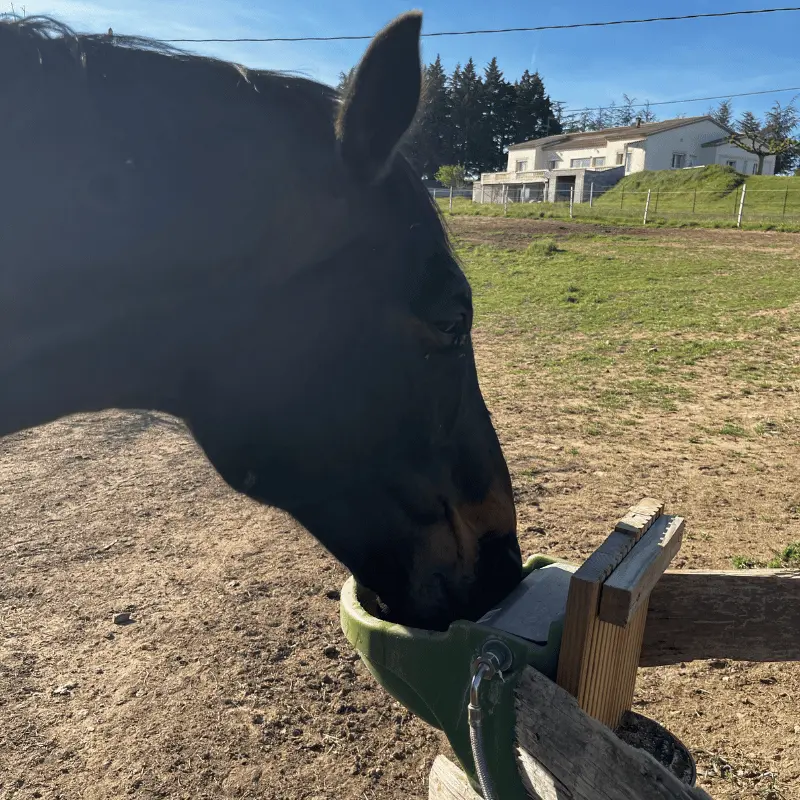
Sur le domaine, le système choisi est un abreuvoir automatique à niveau constant, raccordé au réseau d’eau potable de la ville. Ce dispositif garantit à chaque cheval une eau claire et fraîche, disponible en continu, de jour comme de nuit.
De plus, le système à niveau constant est plus pratique et confortable pour le cheval : il n’a pas besoin d’appuyer sur une palette pour remplir le bol, car celui-ci se remplit automatiquement dès qu’il se vide.
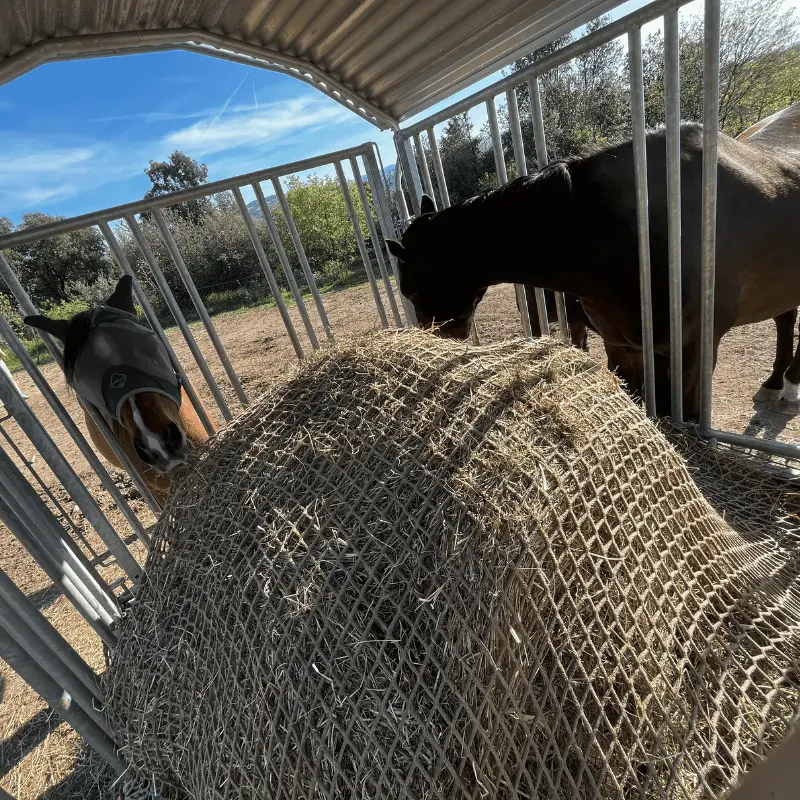
La fibre, sous forme d’herbe ou de foin, est la base de l’alimentation du cheval. Sur le domaine, l’apport en fibre est proposé à volonté avec un foin tardif, moins riche et non poussiéreux, pour préserver leur système respiratoire.
Pour respecter leurs comportements naturels, nous utilisons la technique du slow feeding. En complément, les chevaux reçoivent le CMV MINKO, qui couvre leurs besoins en vitamines, minéraux et oligo-éléments, tout en soutenant leur digestion et leur récupération musculaire.
Cette approche garantit une alimentation adaptée et équilibrée pour leur bien-être.
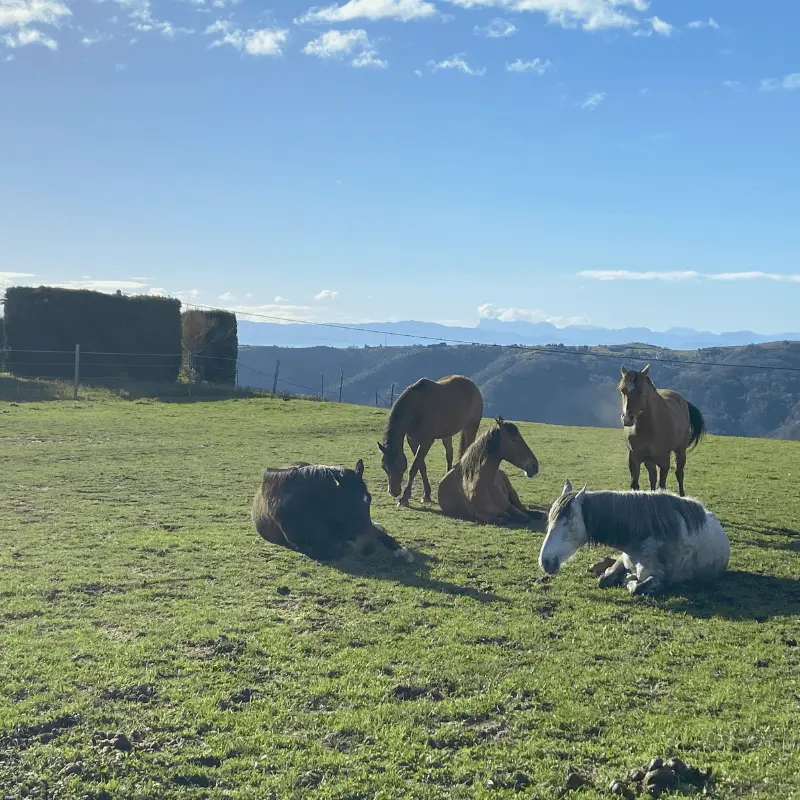
Grâce à la recherche, nous savons que les chevaux ont plusieurs types de sommeil, tous indispensables à leur bonne santé physique et mentale. Cependant, ces différents cycles de sommeil ne peuvent pas tous se dérouler lorsque le cheval est debout. Il est donc essentiel qu’un cheval puisse se coucher.
Pour qu’un cheval se couche, il doit évoluer dans un environnement rassurant, où il se sent en sécurité et où ses comportements naturels sont respectés. Sur le domaine, comme les chevaux vivent en troupeau, ils peuvent se coucher sereinement, à tour de rôle, et profiter de ce sommeil paradoxal si important pour leur bien-être.
Ainsi, pendant que certains dorment au sol, les autres, restés debout, veillent pour assurer qu’aucun danger potentiel ne menace le groupe.
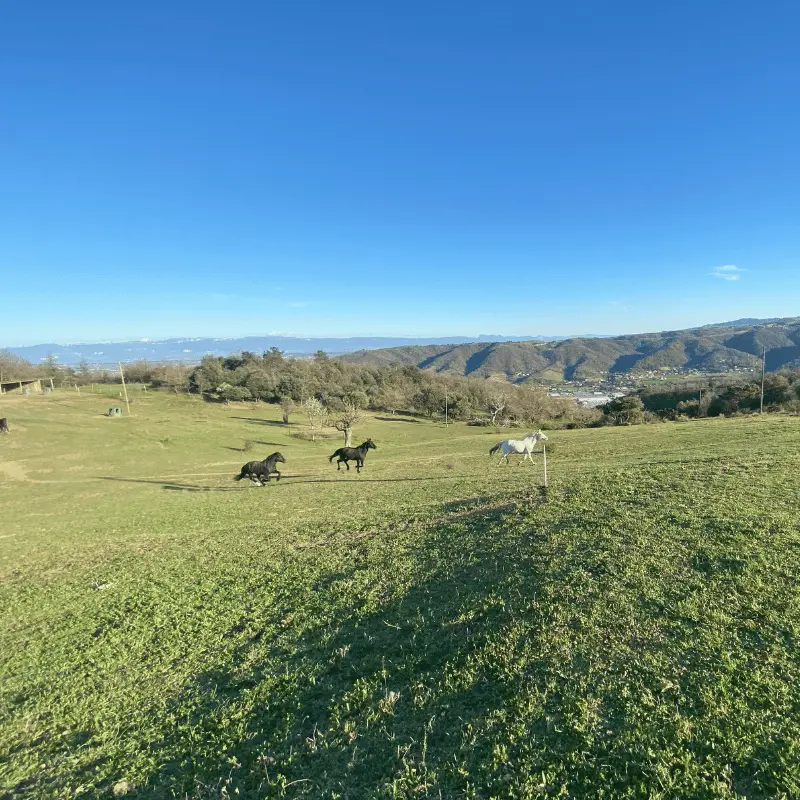
Avant d’être domestiqué par l’homme, le cheval était un animal nomade qui pouvait se déplacer au moins 8 heures par jour, soit pour chercher sa nourriture, soit pour échapper à ses prédateurs naturels. Il est important de savoir que le mouvement est essentiel au bon fonctionnement de son corps. En particulier, il stimule deux systèmes majeurs : l’appareil respiratoire et l’appareil digestif.
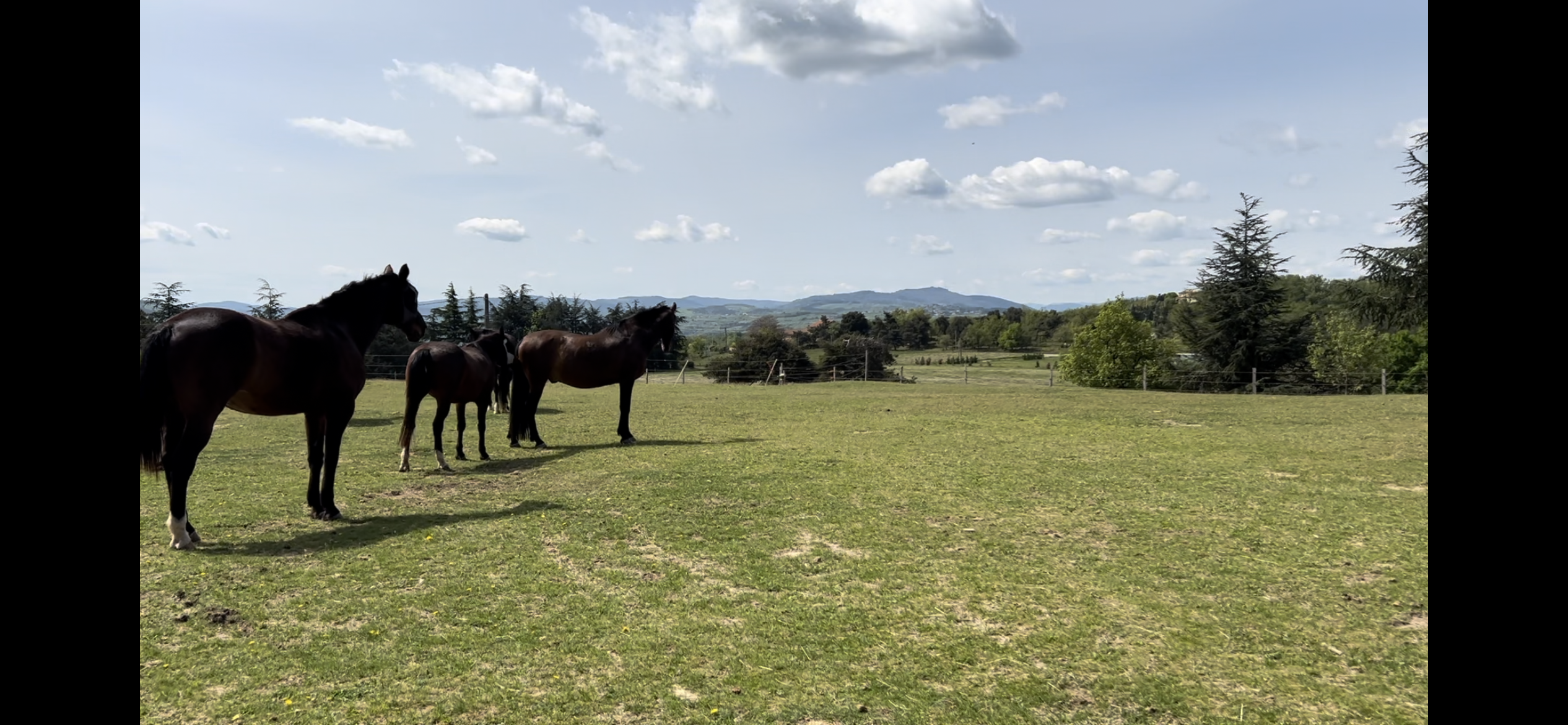
Sur le domaine, les chevaux vivent en extérieur, en troupeau, sur une surface de 1 à 4 hectares, où ils peuvent se déplacer à leur guise et exprimer pleinement leurs comportements naturels.
C’est un réel plaisir pour nous de les voir évoluer librement dans un environnement qui respecte leurs besoins !
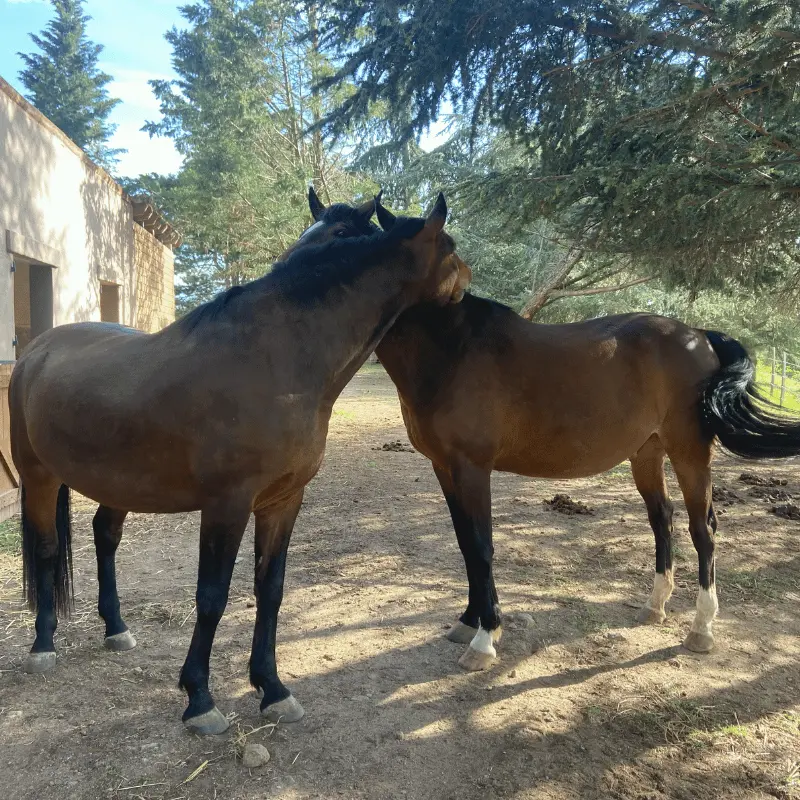
Le cheval est un animal grégaire, ce qui signifie qu’il a besoin de vivre avec ses congénères et d’interagir avec eux. La solitude est anormale pour lui et constitue une source d’angoisse.
C’est pourquoi nous avons choisi un habitat collectif pour nos chevaux. Tous nos chevaux vivent en troupeau tout au long de l’année. Lorsqu’un nouveau cheval arrive, une période de quarantaine et d’intégration, allant de 15 jours à un mois, est nécessaire pour le bien-être de tous.
Une fois l’intégration réussie, les chevaux du domaine peuvent pleinement vivre leur vie de cheval. C’est toujours avec émerveillement que nous les observons s’exprimer et interagir ensemble.
To go even further, we work in close collaboration with different practitioners who work every day to bring greater comfort to horses.
To ensure the safety of our horses, continuous supervision is provided 24/7, with the stable owners living on-site.
In addition, surveillance cameras have been installed throughout the site for increased vigilance.
The pastures' fences intended for the horses are equipped with four levels of electrified wires, providing optimal protection.
In each of the pastures, there are large trees that protect the horses from bad weather. When it's cold (around 0 degrees Celsius) or when it rains, the horses take shelter under the trees, which release warmth that the shelters don't provide. When it's freezing in a shelter, it doesn't freeze under the tree (as long as it's alive). When it's hot, the horses prefer to protect themselves from the sun by seeking shelter under the shelters.
The Somaret Equestrian Estate was designed and created for the well-being of both horses and humans; it is a unique place dedicated to the pursuit of harmony between man and animal.
© All rights reserved 2012 – 2025 Home – News – Legal notice – Contact
Equicoaching is a support method that uses the horse as a partner, to help people get to know and understand themselves better, to become aware of their individuality and their ways of functioning, and thus develop their well-being and their individual and/or collective potential.
Equine coaching will be just as interesting for an individual who wants to boost their self-confidence as it is for a senior executive who has high stakes and who sometimes tends to be more authoritarian than justly authoritative in their relationships. In terms of teamwork, equine coaching can be offered with the intention of building cohesion, mediating change management, or managing conflict.
With unsuspected potential, the horse, in its authentic relationship, becomes a wonderful mediator. Devoid of judgment and strategy, it induces a "natural mirror" reflection, instantly revealing behaviors and their consequences on oneself and on the group, which allows the development of professional behavioral skills (so-called soft skills).
Definition: Hippotherapy is a practice of motor rehabilitation using horses.
L’hippothérapie utilise le mouvement tridimensionnel du cheval as a therapeutic means. The equine's gait actually replicates the human walking movement. This helps the rider improve their neuromotor functions.
Hippotherapy allows in particular to:
Strengthen your muscle tone,
Adjust and control your posture,
Improve your balance,
Relax the muscles,
Improve coordination of movements,
Encourage social interactions,
Reduce spasticity (muscle stiffness),
Call upon intellectual faculties (memory, concentration, reasoning, problem solving, etc.).
Improve joint range of motion, stability, fine motor skills, etc.
Definition:Equine therapy is a psychological treatment mediated by the horse and provided to a person in their psychological and physical dimensions.
Equine therapy allows children with pathologies such as autism, for example, or children or adolescents with behavioral disorders (impulsivity and aggressiveness), or victims of violence and abuse, to:
Entrer en interaction avec le cheval,
Regulate their emotions,
Create a relationship of mutual respect,
Develop empathy skills,
Develop emotional and social skills.
Objective: To enable any individual, with or without a disability, to practice horse riding.
When it comes to horses, every human being is on an equal footing. To enjoy the benefits of horse riding, there is no need for social criteria: horses only speak their own language, and every human being is capable of communicating with them, regardless of their level of ability.
Physical disability is not an obstacle to practicing horse riding. Like many others, this sport has adapted to allow people with disabilities to participate in several disciplines, including competition. For its rider, who, when on foot, finds himself deprived of some of his movements by his disability, the horse becomes an extension of his body.
Horse riding is an inclusive sport based on the relationship between humans and horses. Regardless of the level or discipline practiced, trust, communication, and mutual respect are the keys to a peaceful, efficient, and safe practice. Through contact with horses, humans naturally deepen these values, regardless of their physical or mental abilities.
The agricultural world is currently facing a major problem: land pressure. Environmental enrichment and thoughtfully designed housing can significantly reduce the space horses need to move around comfortably together.
Studies show that 90% of droppings are found where the horse eats. We will therefore stabilize this area so that the droppings can be collected mechanically using a tractor and a sweeper, rather than by hand. At the same time, stabilizing this area will help keep the horses' feet dry almost all the time since they spend a large part of their time eating hay.
Herd life
Outdoor living
Continuous, fiber-based power supply
Activity ++++
Expression of natural behaviors
In the wild, horses must travel many kilometers each day to find food. Thanks to the Automatic Concentrate Feeder (ACF) and the Automatic Hay Feeder (AHF), the active stable can recreate this and allow our modern horses to get the daily activity they need. And this is something no other housing system can do.
Are you looking for accommodation for one night? For a few days or longer?
We provide quality mobile home rentals in our area.
Spacious, independent mobile home on private land with space for parking cars.
Shower room with sink, 1 WC, 3 bedrooms, 5 beds in total, a fitted kitchen, a living room with TV, a Wi-Fi connection is available free of charge.
Kitchen: dining table, hob, oven, cooking utensils, microwave.
Available all year round.
Rentals are available for one night, a weekend, a week, or longer, subject to availability. Contact us for any other requests. Contact us for terms and conditions.
Pets not allowed.
Mobile home located in the annex of a stable with the possibility of accommodating several horses. Rates and conditions available upon request.
Pour bien terminer la journée, un petit spectacle est proposé aux enfants, enseignants et parents accompagnants, dans le but de montrer le lien qu’il est possible d’avoir avec un cheval, lorsque la relation du cavalier avec son cheval est empreinte de douceur, de respect, d’écoute et d’empathie.
Les enfants partent pour une balade en forêt, accompagnés de leurs instituteurs et des parents accompagnants, à la découverte de la faune et de la flore très diversifiée qui entoure le domaine. Les enfants sont encouragés à être attentifs à ce qu’ils voient, entendent et sentent durant la promenade, afin de bénéficier d’une promenade en pleine conscience.
Sous le dôme géodésique les enfants découvrent le yoga adapté aux enfants. Ils mettent en pratique les postures qu’ils voient dessinées sur les parois du dôme.
Le yoga peut aider les enfants à canaliser leur énergie, mais aussi à développer leur sens de l’équilibre (mental et physique), et à prendre conscience de leur corps dans l’espace. Il permet d’aborder des notions de bien-être, de bien respirer et de détente.
The children explore this very special and innovative stable, accompanied by their teachers and accompanying parents. This type of accommodation, being the one that best meets the needs of horses, is therefore perfectly suited to present it to future generations.
Cécile Roussel, an equine behaviorist, also works at the Écuries de Gaboulion. Her patience, humanity, and kindness toward each individual truly impressed us.
« I am a certified equine behaviorist, graduated from the University of Rennes in 2015 and accredited by SFECA in 2019.
Through the various services I offer, all built primarily on scientific knowledge of equine ethology, I am constantly seeking an authentic human-horse relationship—one in harmony, where two individuals of different species come together to form a connected duo… free in movement and expression, ultimately reaching grace!!
I pursue this quest for human-horse unity alongside you, guiding you in creating, maintaining, and strengthening the bond you share with your horse. Together, we explore how to achieve it. »
After a background in outdoor sports and a period of globetrotting, my path led me to training as a Horsewoman.
The fundamentals and equestrian approach were taught to me by Gina Pitti, whose values I share.
The training as a riding instructor and equestrian trail guide at the Ferme des 4 Chemins in Chichilianne now allows me to share knowledge and skills to support your riding.
Hello everyone! My name is Mathilde Roques
I have held the BPJEPS since 2017, and I also have numerous other sports qualifications, which provide me with real practical versatility for teaching and sharing knowledge.
I work extensively on the ground, with long reins, in liberty, and on flat work; when it comes to jumping, I tend to focus on Hunter style. In all cases, my goal is to build a strong bond and quality in your long-term rider-horse relationship.
I have a wide range of tools at my disposal to help many of you progress in a personalized and tailored way.
The work of a nutritionist is a long-term endeavor, where one must constantly "keep both sides happy," balancing negotiation, diplomacy, and psychology. This discipline, often little known and usually reduced to the mere use of feed ranges, is in fact a true gateway to understanding the Human/Horse relationship.
When performance improves, it is simply because the basic principles of a horse’s life were not respected before: free-choice forage, mobility, social life, and respect for physical and mental integrity.
I have always been passionate about horses. It was therefore only natural that I decided to work with them.I completed my training at the European School of Equine Dentistry in 2013. I then decided to follow several dentists for three years to perfect my training.I also trained in 2021 in "action and choice of the bit" with the IFCA.The well-being and attentiveness to horses are essential to me. I therefore allow the horse to express itself during dental care.
Alina Lukosevicius, nearly 12 years of professional experience in physiological hoof care.
Practicing with passion, equally comfortable with extreme cases (horses that haven’t been trimmed for years, elderly horses with arthritis, or those impaired by injuries) as with barefoot transitions or barefoot horses in work. I myself was a self-sufficient trekker, riding horses entirely barefoot for up to 18 days, which allowed me to observe what worked and what posed challenges.
I am at the service of horses, and in my view, hoof trimming should provide them with well-being both during and after the process. My unwavering calm and attentive listening help them through the trimming. I trim donkeys and mules just as well as ponies and horses, and occasionally other “hoofed creatures.”
My credo, “Well in Their Hooves”, is the name of my Facebook page.
I am Maylie Faure, a certified animal osteopath. I have always been passionate about the well-being and health of animals. I use a holistic approach combining tissue, biodynamic, cranial, fascial, visceral, FTM, and energy techniques, while also taking into account the connection with the animal’s emotional system.
My intention is to help animals regain their balance and improve their overall well-being whenever possible.
With the horse’s well-being in mind, I use treatments derived from Chinese medicine. Indeed, training in Eastern medicine came to me naturally, as I am often called upon to care for horses injured by the intensive and demanding practice of competition or presenting injuries that need to be considered in their daily lives. It is with joy that I adapt the bio-résonance aux soins des chevaux.
"Let us not forget that it is not the number or length of its branches, but the depth and health of its roots that determine the strength of a tree."
– Balance and Harmony (1976) by Gustave Thibon